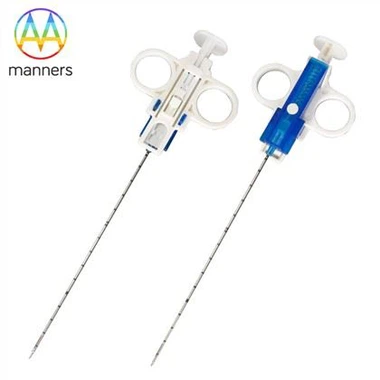
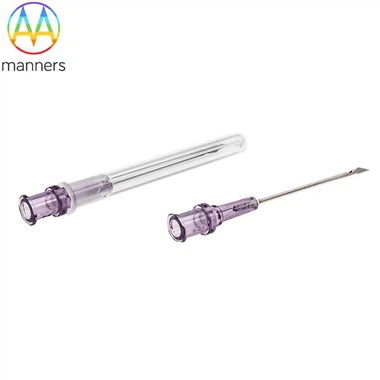
method of biopsy needle
Mar 09, 2022
Biopsy methods for bone and soft tissue tumors can be divided into closed biopsy and open biopsy. Closed biopsy is divided into needle biopsy and core needle biopsy. Open biopsy includes incisional biopsy and excisional biopsy.
1.1 Percutaneous closed biopsy The method of percutaneous closed biopsy was first proposed and applied by Coley in 1931. This method has the following advantages: it is easy to operate and can be performed in outpatient or operating room; it can be repeated or switched to other biopsy methods; the damage is small, the healing time is short, and the contamination to surrounding tissues is small; it is fast and has few complications. The main disadvantage is that the pathological tissue obtained is very small. In addition, tissue extrusion, necrotic debris, and contamination of blood can interfere with accurate diagnosis.
Needle aspiration biopsy is widely used in the initial diagnosis of primary bone and soft tissue tumors, as well as the diagnosis of local recurrence or metastatic lesions, and can also be used for the diagnosis of deep lesions such as the pelvis under imaging guidance. In 1931, Coley et al reported for the first time that needle biopsy was used in 35 patients with bone tumors, and the diagnostic accuracy rate was 70 percent to 90 percent . The diagnostic accuracy of fine needle aspiration biopsy for soft tissue tumors is 64 percent to 96 percent , and the diagnostic accuracy for primary malignant bone tumors is 54 percent . Stoker et al reported an accuracy of 95 percent for needle biopsy.
1.2 Core needle biopsy Core needle biopsy is also called trocar biopsy. Using a trocar to get deep inside the tumor, tissue pellets with a diameter of 3 to 6 mm can be obtained. This method is also repeatable, with little tissue damage. Although the amount of specimen obtained is larger than that of needle biopsy, the trauma is also larger than that of needle biopsy, which may cause hematoma and contaminate surrounding tissues. The overall accuracy of diagnosing bone and soft tissue tumors was 68.5 percent to 95.75 percent . Simon gave a brief introduction to the two puncture methods and the tools used. He believes that an experienced specialist can achieve 90 percent accuracy with a 0.7mm diameter fine needle and 96 percent with a trocar with a specimen slot.
1.3 Incisional biopsy Incisional biopsy is the most widely used method of taking tumor tissue samples under direct vision. Its greatest advantage is that sufficient tissue can be obtained for diagnosis, and histological grading has the highest accuracy. However, this method has more postoperative complications than closed biopsy, the most common ones being hematoma, tumor spread, incision infection, and pathological fractures, especially when the biopsy incision is inappropriately located, it can cause difficulty in en bloc resection, thus losing preservation. Limb condition. However, even with the risk of hematoma, seroma, and pathological fractures, incisional biopsy remains the gold standard for biopsy with 98 percent diagnostic accuracy.
1.4 Excisional biopsy Excisional biopsy is to remove all the diseased tissue and send it for pathology at the same time. It is both a diagnostic and a treatment. The significance of biopsy at this time is only that postoperative histological findings confirm the preoperative diagnosis. Excisional biopsy is usually used for soft-tissue tumors less than 5 cm above the superficial fascia, or for small, slow-growing bone tumors that can be diagnosed.
If you have any questions, please contact us. Our company can produce various customized needles, medical needles, puncture needles, hypodermic needles, biopsy needles, vaccine needles, injection needles, syringe needles, veterinary needles, pencil point needle, ovum pick up needles, spinal needles, etc. If you need customized needle products, please contact us. We look forward to your inquiry! The quality of the products manufactured in our factory will surely satisfy you!
Please contact us if you need: zhang@sz-manners.com